* Closes#36942
* Fixes#19265
Replaces the SSE-based push channel (`/user/events`) with a WebSocket
endpoint (`/-/ws`).
### What changes
- **New `/-/ws` endpoint** (authenticated). One WebSocket per origin,
shared across tabs via a single `SharedWorker`.
- **Pubsub broker** (`services/pubsub`) for fan-out by topic, behind a
`Broker` interface. `MemoryBroker` is the default (single process); a
Redis backend is available for multi-process setups, configured via
`[websocket].PUBSUB_TYPE` / `PUBSUB_CONN_STR`. The internal Gitea queue
was not usable here because it has FIFO/single-consumer semantics.
- **Push-only event production.** Events are emitted by write-triggered
notifiers — `NotificationCountChange`, `PublishStopwatchesForUser`, and
the logout publisher — wired into the existing `notify.Notifier`
interface. No server-side pollers.
- **Typed pub/sub on the client.** `web_src/js/modules/worker.ts` is a
singleton transport; features subscribe per event type via
`onUserEvent('notification-count', cb)` instead of branching on
`event.data.type`.
- **Wire contract** (`UserEventType` union) is shared between the worker
and consumers via `web_src/js/types.ts`, kept in sync with
`services/websocket/events.go`.
- **Client-side periodic polling fallback** kicks in only when the
WebSocket cannot be established (e.g. proxy blocks WS, browser lacks
module-SharedWorker support).
### What's removed
- `modules/eventsource` (SSE manager, run loop, messenger).
- `/user/events` route and `tests/integration/eventsource_test.go`.
- All server-side polling for stopwatches and notification counts.
### Stopwatch multi-tab fix
The navbar stopwatch icon was previously rendered conditionally on `{{if
$activeStopwatch}}`, so tabs loaded before the timer started had no DOM
element to update. The icon and popup are now always rendered (toggled
with `tw-hidden`), and the start/stop/cancel handlers POST silently so
all open tabs reflect the change in real time.
### Deployment note
WebSocket needs the upgrade headers to pass through a reverse proxy,
e.g. for nginx:
```nginx
proxy_set_header Upgrade $http_upgrade;
proxy_set_header Connection "upgrade";
```
Without them the WebSocket cannot be established, and after 3
consecutive failed opens the shared worker signals `push-unavailable`:
the notification count and stopwatch fall back to periodic polling on
the existing `[ui.notification]` timeouts. Real-time push is lost, the
features keep working. The reverse-proxy docs need the same note (see
the `docs-update-needed` label).
---------
Co-authored-by: silverwind <me@silverwind.io>
Co-authored-by: wxiaoguang <wxiaoguang@gmail.com>
Co-authored-by: Epid <rexmrj@gmail.com>
1. use MockVariableValue as much as possible
2. use wg.Go as much as possible instead of Add/Done
3. simplify global lock's DefaultLocker logic to make it easier to test
4. introduce a general approach for getting external service config in
CI
5. remove unclear & unnecessary "t.Skip"
6. use modern generic syntax for remaining "DecodeJSON" calls
7. clarify test result for "list gitignore templates" and "list
licenses"
Replaces #24641

Currently, unit tests fail when run locally (unless users have minio
instance running). This PR only requires redis unit tests if in CI.

- Only run redis unit tests when `CI` env variable is set
- Add minio as a service in unit tests actions
# ⚠️ Breaking
Many deprecated queue config options are removed (actually, they should
have been removed in 1.18/1.19).
If you see the fatal message when starting Gitea: "Please update your
app.ini to remove deprecated config options", please follow the error
messages to remove these options from your app.ini.
Example:
```
2023/05/06 19:39:22 [E] Removed queue option: `[indexer].ISSUE_INDEXER_QUEUE_TYPE`. Use new options in `[queue.issue_indexer]`
2023/05/06 19:39:22 [E] Removed queue option: `[indexer].UPDATE_BUFFER_LEN`. Use new options in `[queue.issue_indexer]`
2023/05/06 19:39:22 [F] Please update your app.ini to remove deprecated config options
```
Many options in `[queue]` are are dropped, including:
`WRAP_IF_NECESSARY`, `MAX_ATTEMPTS`, `TIMEOUT`, `WORKERS`,
`BLOCK_TIMEOUT`, `BOOST_TIMEOUT`, `BOOST_WORKERS`, they can be removed
from app.ini.
# The problem
The old queue package has some legacy problems:
* complexity: I doubt few people could tell how it works.
* maintainability: Too many channels and mutex/cond are mixed together,
too many different structs/interfaces depends each other.
* stability: due to the complexity & maintainability, sometimes there
are strange bugs and difficult to debug, and some code doesn't have test
(indeed some code is difficult to test because a lot of things are mixed
together).
* general applicability: although it is called "queue", its behavior is
not a well-known queue.
* scalability: it doesn't seem easy to make it work with a cluster
without breaking its behaviors.
It came from some very old code to "avoid breaking", however, its
technical debt is too heavy now. It's a good time to introduce a better
"queue" package.
# The new queue package
It keeps using old config and concept as much as possible.
* It only contains two major kinds of concepts:
* The "base queue": channel, levelqueue, redis
* They have the same abstraction, the same interface, and they are
tested by the same testing code.
* The "WokerPoolQueue", it uses the "base queue" to provide "worker
pool" function, calls the "handler" to process the data in the base
queue.
* The new code doesn't do "PushBack"
* Think about a queue with many workers, the "PushBack" can't guarantee
the order for re-queued unhandled items, so in new code it just does
"normal push"
* The new code doesn't do "pause/resume"
* The "pause/resume" was designed to handle some handler's failure: eg:
document indexer (elasticsearch) is down
* If a queue is paused for long time, either the producers blocks or the
new items are dropped.
* The new code doesn't do such "pause/resume" trick, it's not a common
queue's behavior and it doesn't help much.
* If there are unhandled items, the "push" function just blocks for a
few seconds and then re-queue them and retry.
* The new code doesn't do "worker booster"
* Gitea's queue's handlers are light functions, the cost is only the
go-routine, so it doesn't make sense to "boost" them.
* The new code only use "max worker number" to limit the concurrent
workers.
* The new "Push" never blocks forever
* Instead of creating more and more blocking goroutines, return an error
is more friendly to the server and to the end user.
There are more details in code comments: eg: the "Flush" problem, the
strange "code.index" hanging problem, the "immediate" queue problem.
Almost ready for review.
TODO:
* [x] add some necessary comments during review
* [x] add some more tests if necessary
* [x] update documents and config options
* [x] test max worker / active worker
* [x] re-run the CI tasks to see whether any test is flaky
* [x] improve the `handleOldLengthConfiguration` to provide more
friendly messages
* [x] fine tune default config values (eg: length?)
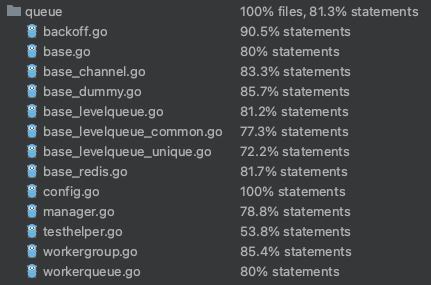
## Code coverage: